Author Archives: Brian Sweeney

About Brian Sweeney

Computer programmer, blogger and home-brew software developer with a penchant for back-country adventures, old metal, black coffee and micro-brew.

Winter Readiness: Winterized Zipper Pulls!

On the surface, this post is almost silly.  But I assure you, the only thing silly about it, is that the industry hasn’t gotten their act together and done this themselves.  Alas, the industry is frequently swayed toward form before function.  Anyhow…

…If you’re wearing your ski jacket, then you’re probably wearing your gloves and you probably have all you can do to access all of the zippered compartments of your jacket or day pack with your maimed manual dexterity.  They give you about an inch of string or fabric to clutch onto with a finger with is like two and half inches thick.  OK, I exaggerate slightly, but you get the idea.


There is a simple solution to this.  Grab you’re favorite ski jacket, buy a few feet of p-cord from your local mountain shop and tie longer zipper pulls onto each of the zippers.  If you plan to be outside for more than  a few hours at a time, you’ll thank yourself that you have arranged your gear in such a way that you never have to remove your gloves.

Cut about 8 inches of p-cord off and loop it through the metal zipper tab.
Tie the biggest burliest knot you can so that you’re gloves or mittens have
more surface to grasp onto.
I’ve used an 8-knot because it’s easily tied, neat, and bulky.  They tend not
to pull out too often either.
As a backup measure and to add extra surface area, I tied a second 8-knot
with the slack ends of the p-cord.
After you’ve cut the p-cord, you can fuse the frayed ends with a lighter to
prevent them from raveling.
Check ’em out in action.  This can be done with back packs, and tents too.
These like the burliest gloves ever.  And the pit zips are hard enough to get
to with no gloves at all…

And that’s it.  Go play outdoors all day without getting cold fingers!


Gear List (click links for more product info):
PMI 3mm Utility Cord - Package of 50 ft.Leatherman Skeletool Multi-ToolBlack Diamond Guide Glove - Men's Natural, MREI Gear ShopFree Shipping on Orders over $50

Winter Readiness: Shakedown Cruise

With winter fast approaching, Ziehl and I figured it was about time for a pre-ski season shakedown cruise on Franconia Ridge. In light of our lofty backcountry skiing ambitions, we felt compelled to benchmark our conditioning on familiar grounds. I also was interested to see how my new shell pants and jacket would perform in alpine conditions. And, with little else to do besides take in the view one step at a time, mountains make the ideal place to get fired up for the upcoming ski season by endlessly speculating as to the snow conditions of various aspects, potential challenges on the approach, estimated ratio of fun to effort…you get the idea. Any way, here’s the map:


View Franconia Ridge November 2011 in a larger map


The forecast was for a high in the mid 40s, mostly sunny, and light breeze.  When we rolled into the parking lot at 9:30, it was mostly cloudy and very windy.  We threw on our shell jackets, packed our bags and hit the trail eagerly.  


A few weeks ago we switched our work out from mostly simple lifts like flat bench and squats to a more dynamic workout with things like split leg squats and kettle swings and also to work more sprints and stairs.  Our thought was that we’d get as strong as possible and then right before ski season we’d cut over to a high intensity workout to build endurance hopefully without loosing much strength.  


We informally agreed to ‘just go as fast as possible’ on the way up Little Haystack to gauge whether or not our ski season conditioning scheme was coming together and if not, how much work might be remaining between now and Christmas.  After a while of hiking, we stopped to take off our shell jackets and take a drink.  After maybe another hour, we stopped for a breather-snack combo.  We were slowed down by about a half mile of hard-pack and water ice.  Shortly thereafter we broke treeline and hit the summit of Haystack at 11:30 AM.  We speculated that the only adjustment to our conditioning scheme should be to go forward full steam ahead – it seemed to be paying off.  We threw our jackets back on, had a Cliff bar and went after Lincoln.

Ziehl near the Haystack treeline.
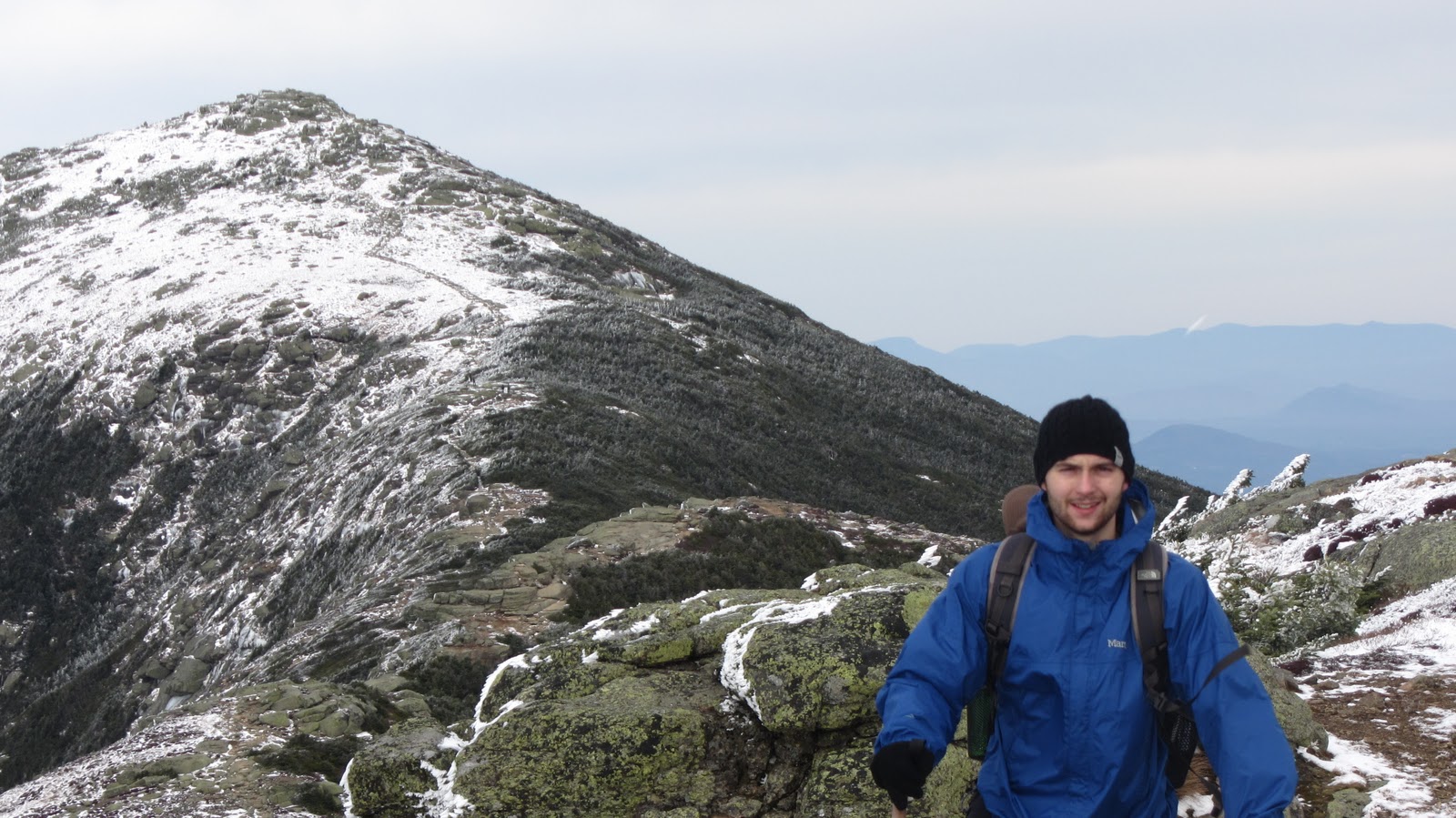
Me at the summit of Little Haystack.
Photo Credit: Ziehl

We spent most of the walk from Haystack to Lincoln discussing our plans to try and ski every single chute slide and gully on either side of the ridge.  Between the newly wintery conditions found above treeline, the outstanding offering of ski films this year, and encouraged by our sturdy pace, we could hardly contain our excitement for the ski season.

Ziehl, and the road ahead.
The ridge, and it’s numerous exciting-looking descents.
Photo Credit: Ziehl
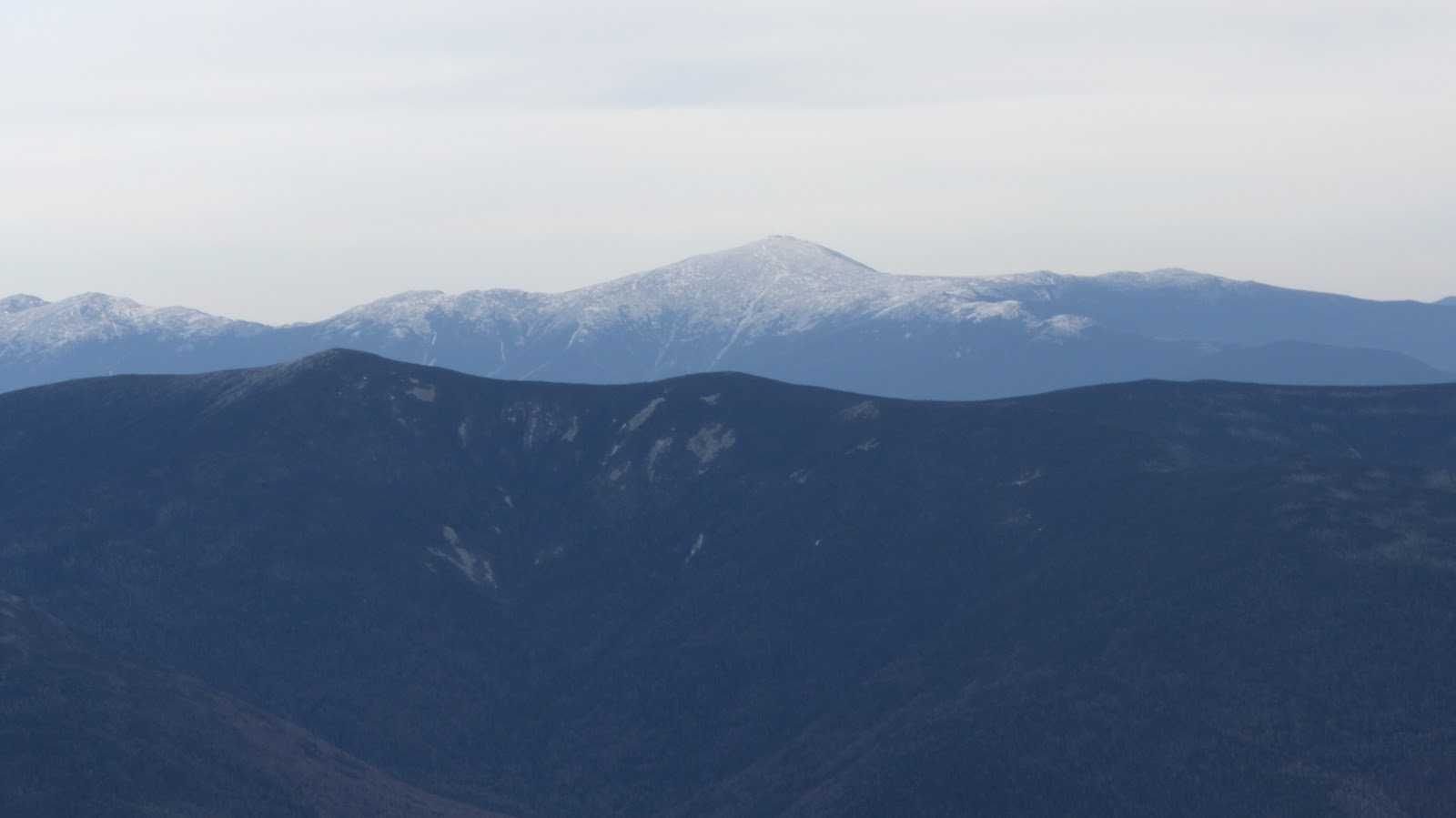
Mt. Washington and the Presidentials.  The Bonds are in the foreground.
Before we knew it, we’d cruised over Lincoln and made it to Lafayette.  According to the tracklogs we summit-ted in just under 3 hours (including packing at the car).  Mission success!  We quickly scoped out the old hotel foundation at the summit (a potential ski-touring camp) and made our way down from the ridge toward Greenleaf.
On our way down from Lafayette.
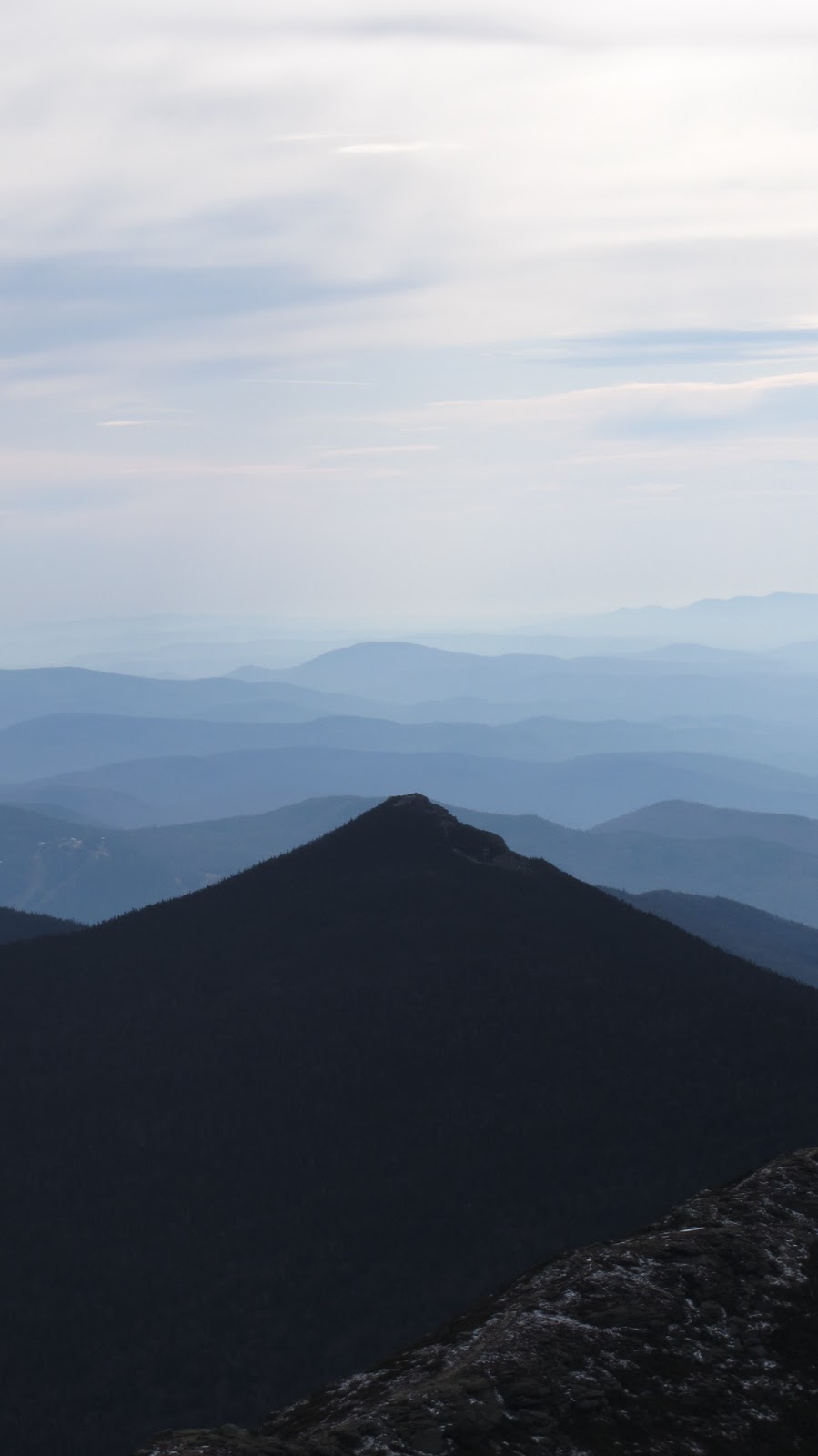
Facing south on our way to Greenleaf.

As we made the dogleg toward the south back to the parking area we got plenty of great views of the Southern Whites, and the Ridge we’d just come down from.  I think that one of the hallmarks of this hike are the opportunities to look back at the terrain you’ve just traveled from a new perspective.

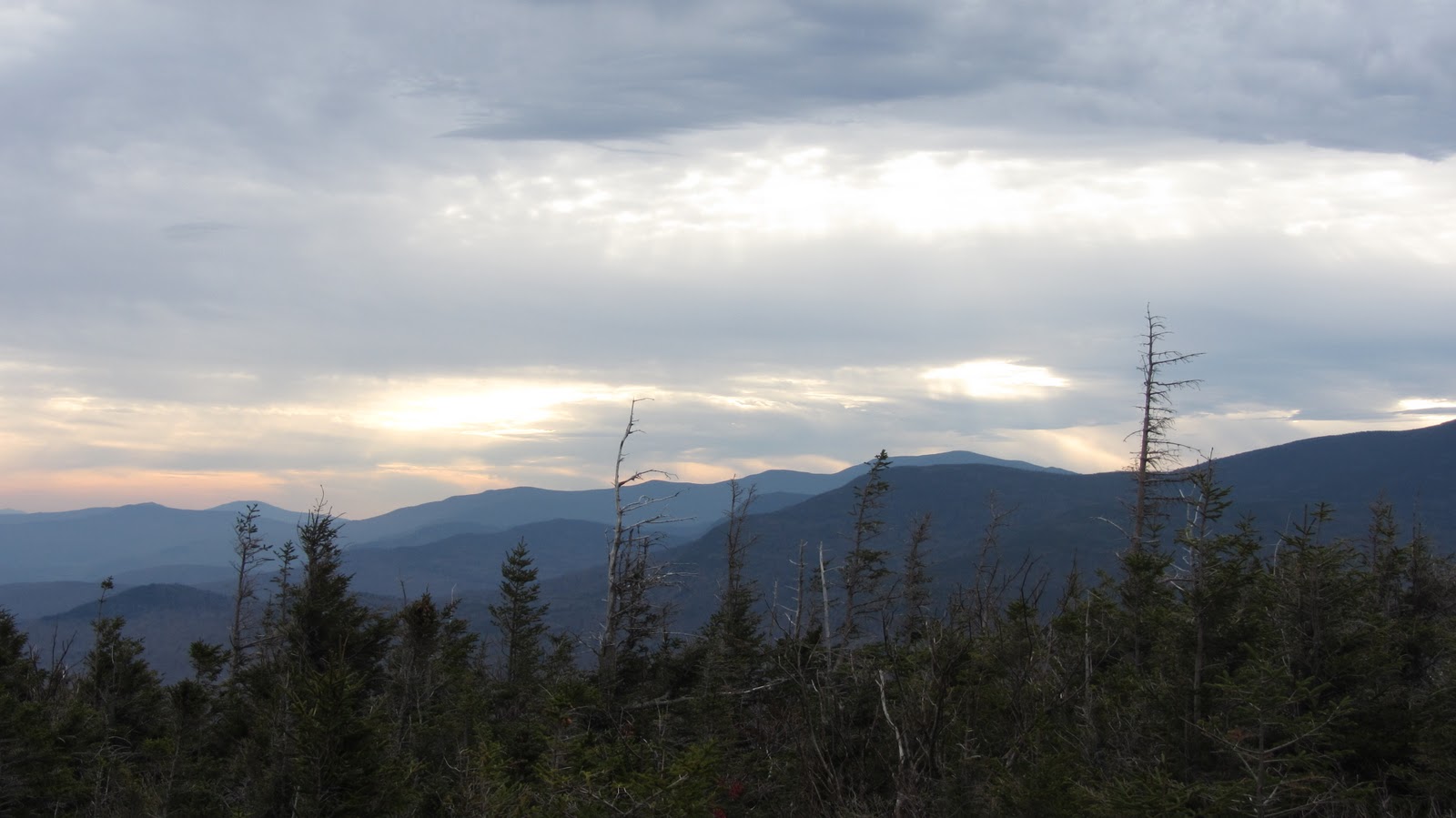
Southern White Mountains.
Rays of light from Greenleaf.
Ziehl with Franconia Ridge in the background.
Nearly sunset.
Left gully: I have no clue; Right gully: Lincolns’ throat.  If anyone knows
the name of the lines in the left gully, please comment!
More sunset.
Detail of Lincoln’s Throat.  Gnarly.

In just under 5 hours we arrived back at the car.  We changed and went straight for the Tilton Diner for a post hike feast.


Gear List (click links for more product info):
Mountain Hardwear Compressor Insulated Hooded Jacket - Men's Blue Chip Sapphire, SMountain Hardwear Compressor Pant - Men's Black, S/RegOakley Bruce Irons Signature Hijinx SunglassesMerrell Chameleon4 Ventilator Gore-Tex Hiking Shoe - Men's Merrell Stone, 12.0Black Diamond Contour Elliptic Carbon Trekking Pole Ink Blue, One SizePatagonia Capilene 1 Graphic Crew - Men's Mango, LREI Shuksan Pants with eVent Fabric - Men's 32REI Gear ShopFree Shipping on Orders over $50

Winter Readiness: Black Diamond Factor AT Sole Block Install

In the spirit of the recent post regarding testing my winter load-out, I decided to document my various winter preparation activities just in case any of this eclectic trivia or minutia should be of use to anyone else out there. (And judging by the searches by which people seem to arrive at this site, at least some of this might be useful information…) So, here’s the first topic in the Winter Readiness series: How to install a set of AT Sole Blocks on the Black Diamond Factor boot.


First, let’s have a quick look at all of the moving parts:

Exploded: Boots, blocks, hardware, liners.
Close up: the alpine blocks to the left, the AT blocks to the right and
the included hardware in the center.

I’ll assume most people will have purchased the boots with the Alpine block pre-installed (at least that’s what happened in my case).  In any event, the process of removing and replacing the either set of blocks is identical.

The first step in removing the sole blocks is to unbuckle everything, remove the liner, yank out the boot board, and flip them into walk mode, just for some extra wiggle room.

Das Boot.
Unbuckle and unstrap.
Remove liners and boot boards.
Flip into walk mode.

The next item on the agenda is to remove the alpine blocks by unscrewing them and prying them off of the boot.  Let’s first take a closer look at the hardware involved.

Button heads with #2 Philips fittings and flat heads with Allen wrench
fittings.
Number 2 Philips driver, included Allen
wrench, a hammer, the screws.

To remove the toe pieces unscrew the two machined flat heads near the toe welts using the included Allen wrench.  Pry upward on the toe welt of the sole block.  With enough force it will pop loose, allowing you to pull the toe block backward and completely clear of the molded plastic fittings.

Unscrew with Allen wrench.
Pull upward on the toe welt.
With the toe loosened, pull back on the entire block until it breaks free of
the molded plastic fittings shown below.
One down, four to go!

Next step: remove the heel piece.  This requires that you locate the two #2 Philips head screws under the boot-board and back them out.  Once this is accomplished, you can bang the block off of the boot with a few carefully placed hammer swings.

Back out the two heel piece screws.
Hammer the heel piece off.  Fairly careful aim is required to have any effect:
you want to be sure to strike only the heel piece or else the sole of the boot
will absorb the force rather than the heel block.


Enlarge to see the heel block has slid off of it’s molded fittings on the boot.
It can simply be pulled off now.

While you’re at it, you should probably repeat this process on the other boot.  Now to put the AT blocks on.  Let’s have a close look at those:

A careful inspection of the sole blocks reveals that each is labeled with a
capital R or L

We’ll start with the toes.  Be sure to grab the correct block.  Fit the rear portion of the toe block over the plastic moldings just forward of the middle of the boot – they should hook on.  Once the rear of the toe block is firmly hooked on, press down on the toe block over the toe welt until it snaps into place.  Finally, the toe piece can be locked down using the two flat head screws fitted for the Allen wrench.

Place the heel block over the plastic moldings and press forward until the
toe piece is firmly seated.


Press down over the toe welt until the toe block snaps into place.
Lock it down using the two flat head screws with the Allen wrench.

Next step: the heel block.  Grab the appropriate heel block and slide it forward ensuring first that the forward grooves are seated correctly, and second that the rearward grooves follow into place.  You should see any gaps between the heel piece and the boot if this has been done correctly.  You may need to persuade the heel piece into position with a few hammer swings.  Once it’s in place, you can drop the two Philips head screws into place from the top of the boot and crank them down using a #2 screw driver.

Slide the heel block over the molded grooves near the boot center, and then
be sure that the rear grooves have followed into place.
You need to exert a bit of downward pressure to keep the grooves lined up.
Finally bang things into place with a few hammer strikes.
Replace the two Philips head screws and tighten them.

Repeat this process on the second boot.  Replace the boot boards, the liners and buckle things up again (boots keep their form best with all buckles and straps secured during storage).

Done!

And with one less Winter Readiness chore checked off my list, I think I’ll kick back with some light Sunday afternoon reading…

Should be a good winter!

Gear List (click links for more product info):
Black Diamond Factor 130 Alpine Touring Boot - Men's Black/Envy Green, 27.5Black Diamond AT Sole Block Envy Green, L Free Shipping on Orders over $50

15 Miles

Last weekend Ziehl and I pulled off our multi-day Bigelow Range / Flagstaff Lake excursion, as per our plan discussed earlier.  Our party unfortunately unraveled towards the last minute, with the final roster consisting of just the two of us.  We made some quick logistics adjustments (less cars, less boats) and went for it.  As it turned out, our shortened roster would actually be the least of our troubles before the end of the trip!  The full trip report follows. Friday We decided it might be prudent to get started as early as possible on Friday.  The original plan called for a Friday afternoon/evening departure with a goal of accommodating most people’s schedules, but now that our team was down to just two, we amended the plan and hit the road around 10 AM.  Ziehl swung by my place with the Pathfinder, I threw all my gear in the trunk, and we were off and running.
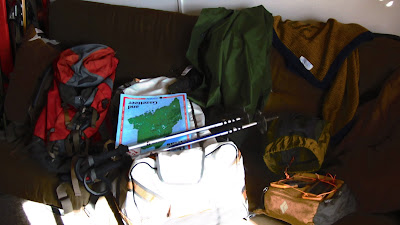
I swear, we’re only going to be gone for a few days…

We had two scheduled pit stops on the way to Maine: once at Ziehl’s family’s house to retrieve some extra dry bags and a carbon fiber paddle, and once at my family’s house to pick up the boats and life jackets.  Stop number one went just fine, stop number two on the other hand marked the first official mishap of our adventure.  We pulled the kayaks out of the basement, and got ready to throw them on the roof with the Thule J-bars when we realized that I had left half of the hardware in the back of my car in Boston.  Instead of going all the way back to Boston, we went back to Ziehl’s house and took the hardware from his mounts.  Even with this major blunder on my part we still managed to hit the road around 1 PM. With Ziehl doing the driving this time, I took charge of the co-piloting for the weekend.  When Tripp and I did this trip last fall, we had a Hell of a time finding the campground in the dark with no cell service.  With cell service we could easily have used the GPS in my phone to figure out exactly where we were, but without cell service the navigation software can’t download the map tiles for the given region.  This time around, I made sure to pre-cache map tiles in advance.  Just because I love redundant systems, I used Google Maps Labs to cache tiles in the Android Google Maps app, and I pre-cached the same region in Backcountry Navigator Pro.  All of this may seem slightly excessive, but we felt a lot better about travelling on roads of dubious condition in the dark in unfamiliar territory with the ability to scheme up a Plan-B in a pinch. The next order of business, was getting the GoPro squared away for use with the Kayaks.  This was pretty much the maiden voyage of the GoPro, so I wanted to make sure that I had all of the settings dialed in before we got out in the woods, where I’d likely be too busy or tired to take my time and do it right.  This was actually a non-trivial activity.  The GoPro is pretty incredible from an industrial design standpoint, but the UI leaves a bi to be desired.  Given the circumstances (only two hardware buttons to work with), they actually do a pretty good job.  Anyhow, I set it to take one hi-res photo every 60 seconds for the duration of the trip.  It seemed to me that video of 7 hours of paddling might be a bit tedious, but tons of still photos might yield a few cool shots. After a few stops for gas and sandwhiches we rolled onto the access road to the Round Barn Campground where we would drop our kayaks.  By now it was about 7 PM and not yet totally dark.  We found the waterfront day use area of the camp ground and prepared to unload the kayaks in the fading light.  Right then, we ran into a crazy old Irish guy watching the sunset from his VW Eurovan.  We end up telling him our plans for the weekend and were excited hear that he had just run into two other people doing the same loop as us, but in the opposite direction.  Until then, we were worried that we might be planning an overly ambitious trip.  The next thing he said was cause for concern; we told him how we intended to get from Round Barn to Trout Brook and he informed us that last time he was down that road a bridge was missing and that the only option was to ford the stream with steep embankments on either side.  We decided to take a shot at it anyway – if it was really in bad shape we’d have to find another way around.  The series of setbacks ensued, summarized best in this map:


View Flagstaff Adventure in a larger map

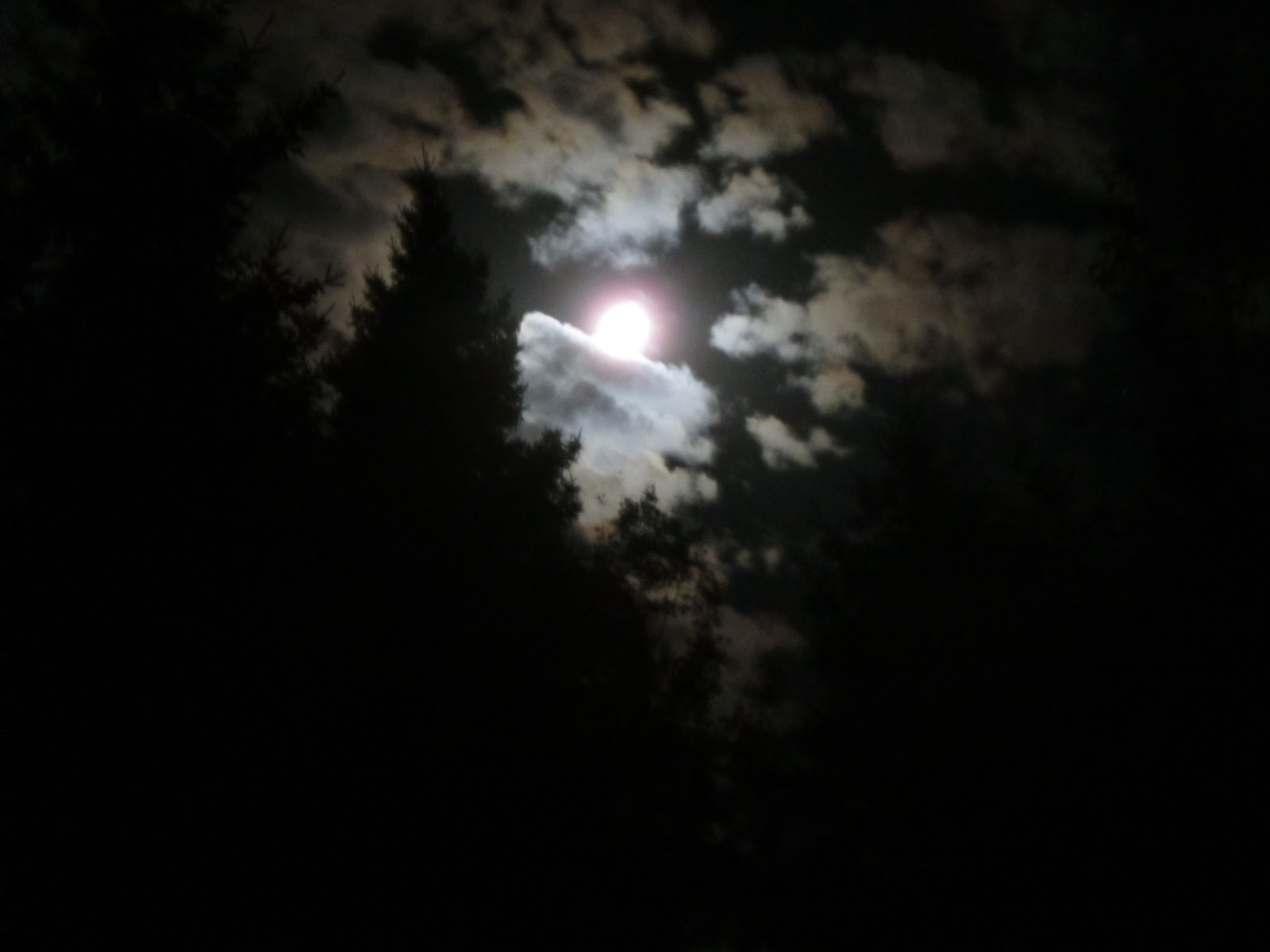
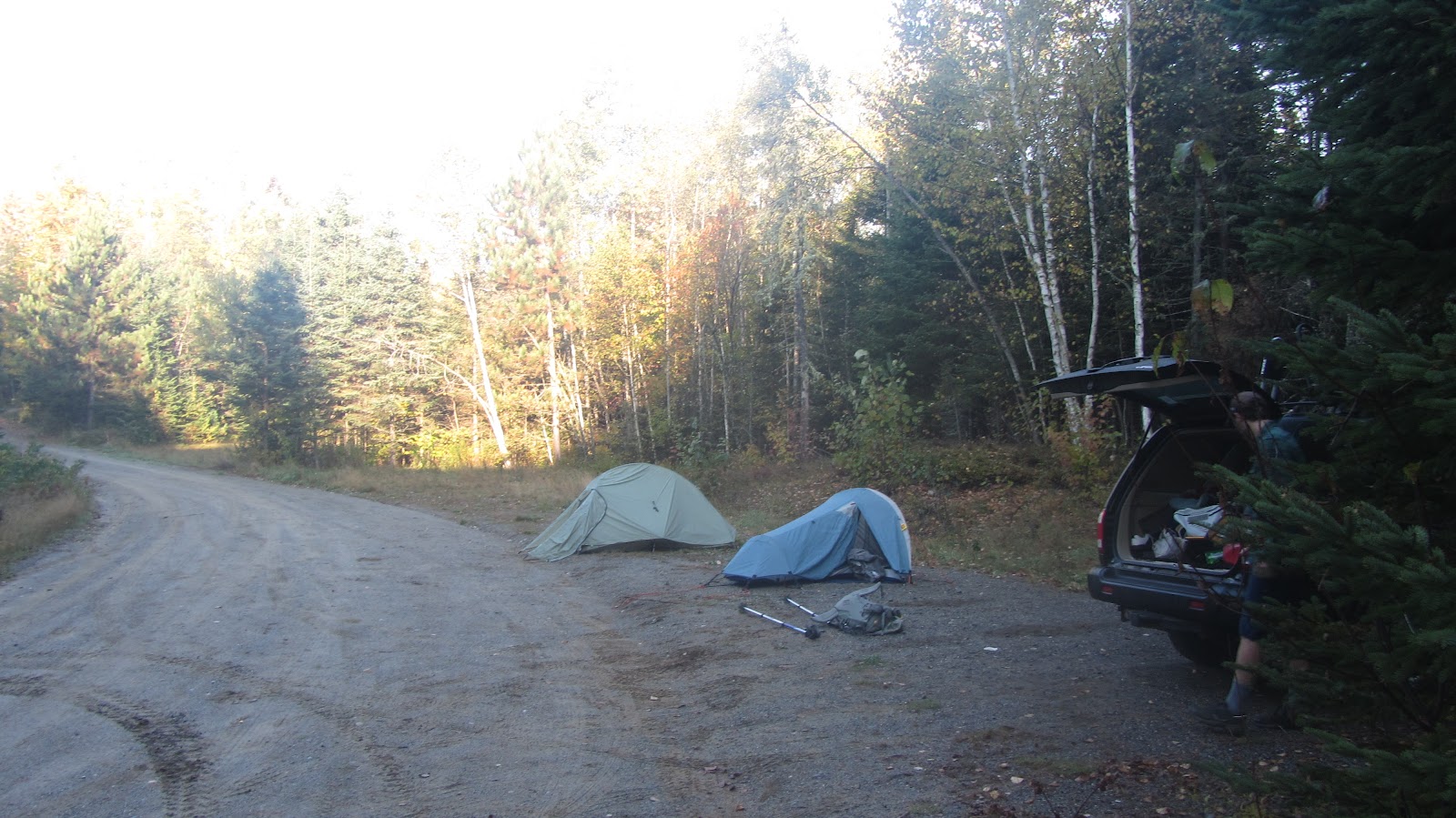
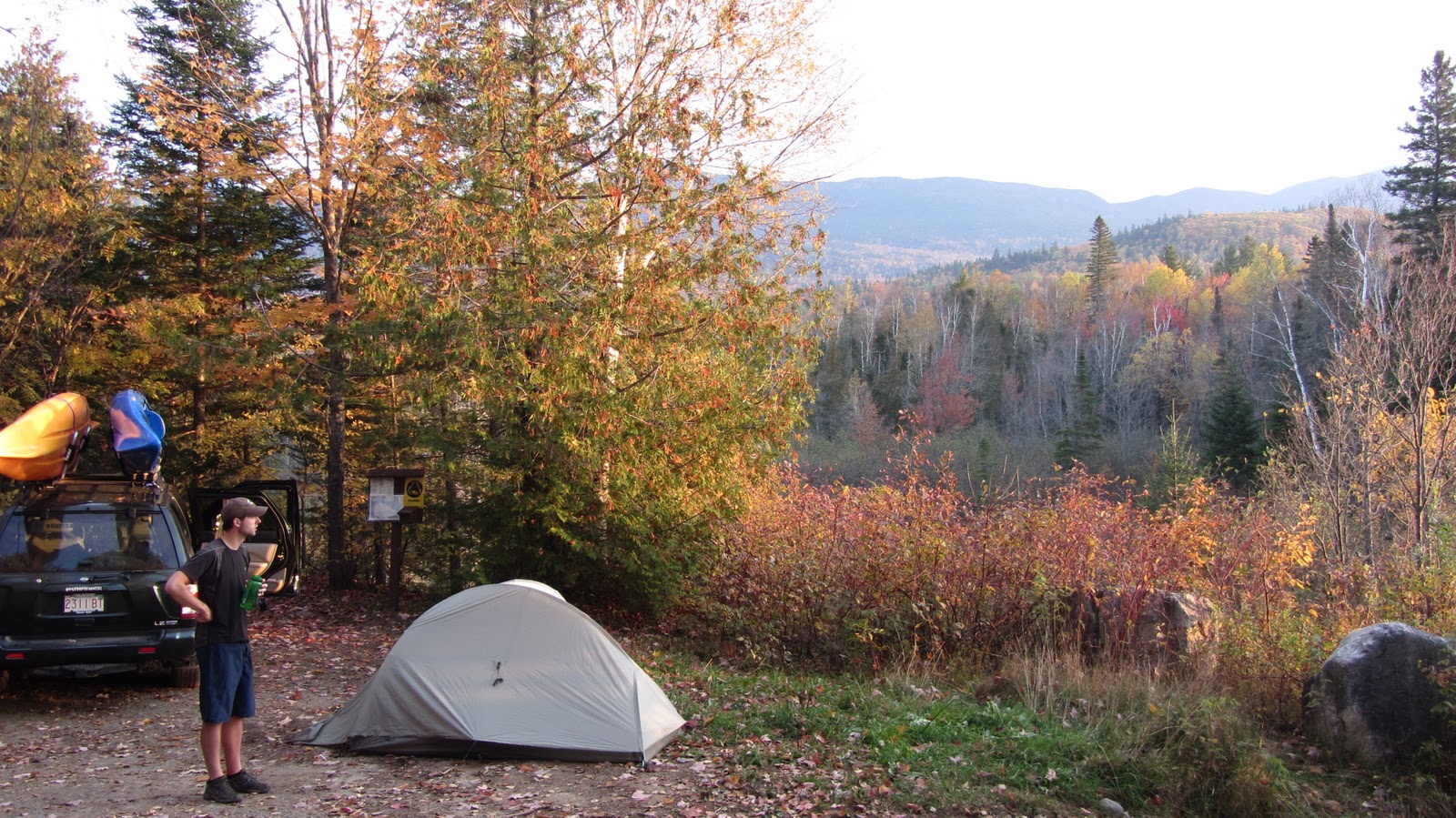
Here’s what happened.  We headed west from Round Barn down East Flagstaff Road, which according to the map connects with West Flagstaff Road and eventually goes straight past Trout Brook Campsite, where we intended to camp.  This was supposed to be about 15 miles long and we expected it to take an hour or so. East Flagstaff Road was in pretty rough shape, but Ziehl’s Pathfinder was up to the challenge.  After about an hour of plodding through the woods in 4-wheel drive we came to a huge red steel gate.   We’d only come about 3 miles.  After swearing a whole bunch we looked at the map and realized that we must have taken a wrong turn about a mile back.  We turned around, found the turn we missed and instantly recognized why we’d missed it in the first place.  The road was totally grown in with 10 year trees.  We ended up backtracking the the entire three miles and finding a road to the south of the range called Carriage Road.  Carriage Road was another route of dubious quality.  We passed it on the way to Round Barn and it was just a dirt path through the woods.  We had no idea if we might encounter similar troubles.  The only other alternatives would have taken us significantly out of our way. The Carriage Road turned out to be smooth sailing and we quickly popped out of the woods at Rte. 27/16, which apparently had been destroyed in several places by Hurricane Irene.  In many places it was still down to one lane.  We arrive in Stratton around 9 or 10 PM in search of Trout Brook Campground which should have been a convenient spot to spend the night.  All we could find was a large, swampy, clearing full of dead trees and brush.  Maybe more evidence of Irene?  In any event, we decided to just drive to the trailhead and camp there. According to the map, the trailhead was at the end of Reservoir Road in Stratton.  We found Reservoir Rd. easily and quickly found that it was gated off by a sparkling new, chain link fence.  Starting to run out of patience, we jumped out of the car, GPS in hand and followed a snowmobile path around the back of the fenced off property to the trailhead.  From the trailhead parking area, we were able to backtrack out to the road and back to the car via some dirt road, not on any of the maps we’d looked at.  It was at least 11 PM and we were anxious to try out the Gritty’s Halloween Ale we’d picked up, so we grabbed our headlamps and threw together a hasty campsite in the parking lot.  Turns out the view from the parking lot wasn’t too shabby…

Nearly a full moon.

Saturday We rolled out of bed at 9 the next day, had some oatmeal, loaded our packs and were on the trail by 10.  The day called for roughly 15 miles of hiking over 4 peaks.

View Flagstaff Adventure in a larger map There would be a lot of elevation change and we had overnight gear, extra layers, food, water treatment equipment, the cameras and other gadgets, and shell pants and jackets.  We had no idea what the weather would be like this time of year. As it turns out the weather was basically perfect: 60-70 degrees, mostly sunny, light breeze.  We could have skipped the extra layers and shell pants, and probably should have, because there were a lot of steep climbs.  The hike turned out to be long and fairly difficult, but well worth it.

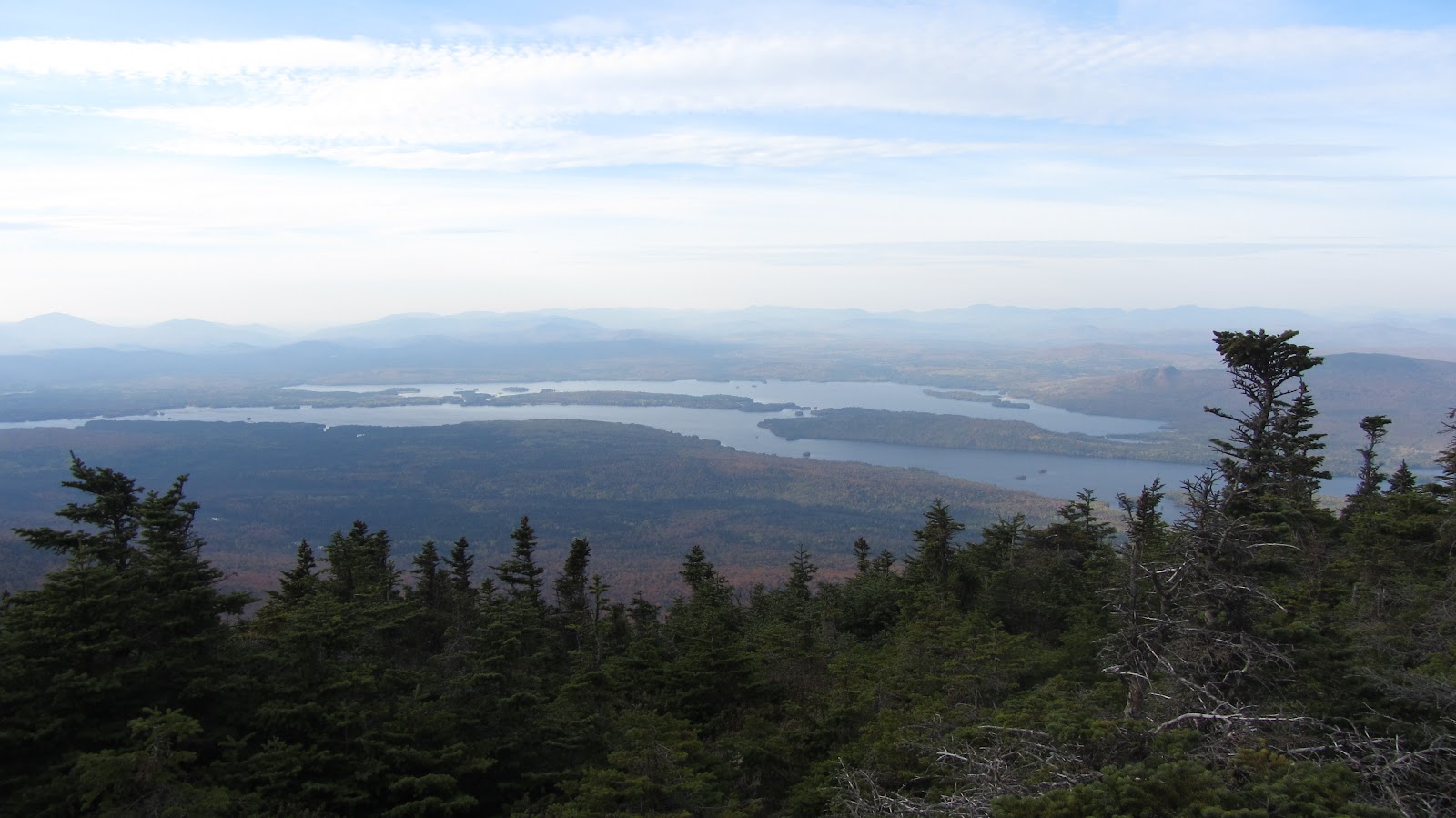
From this panorama you can actually see most of the hike and the paddle!
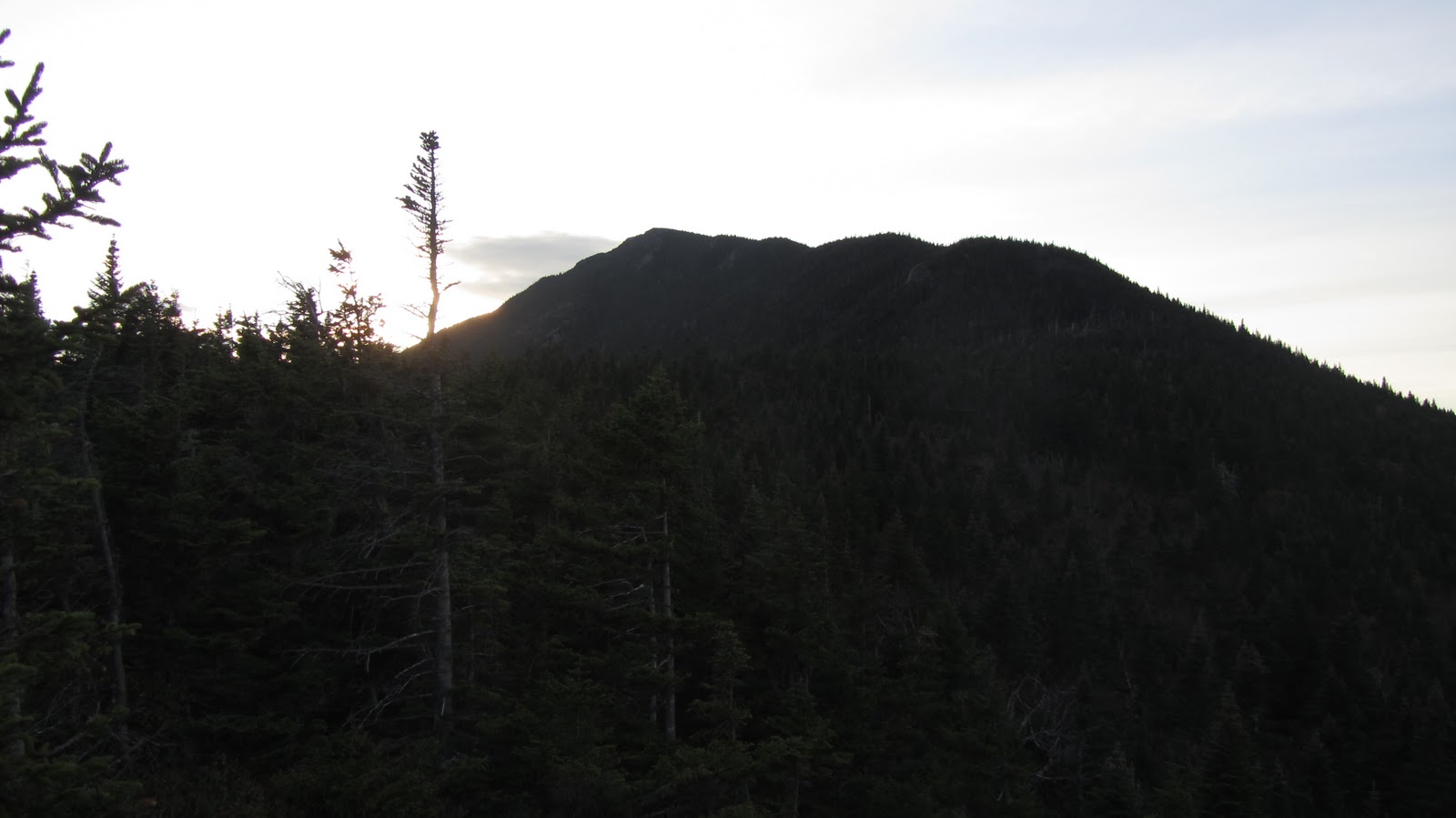
Looking north west – the ridge we just came over is to the left.
You can see how steep the ridge is – it falls away sharply to both sides.
We refilled our water at this MATC camp site.
Scoping out Sunday’s activities…
One of the last big climbs of the day.
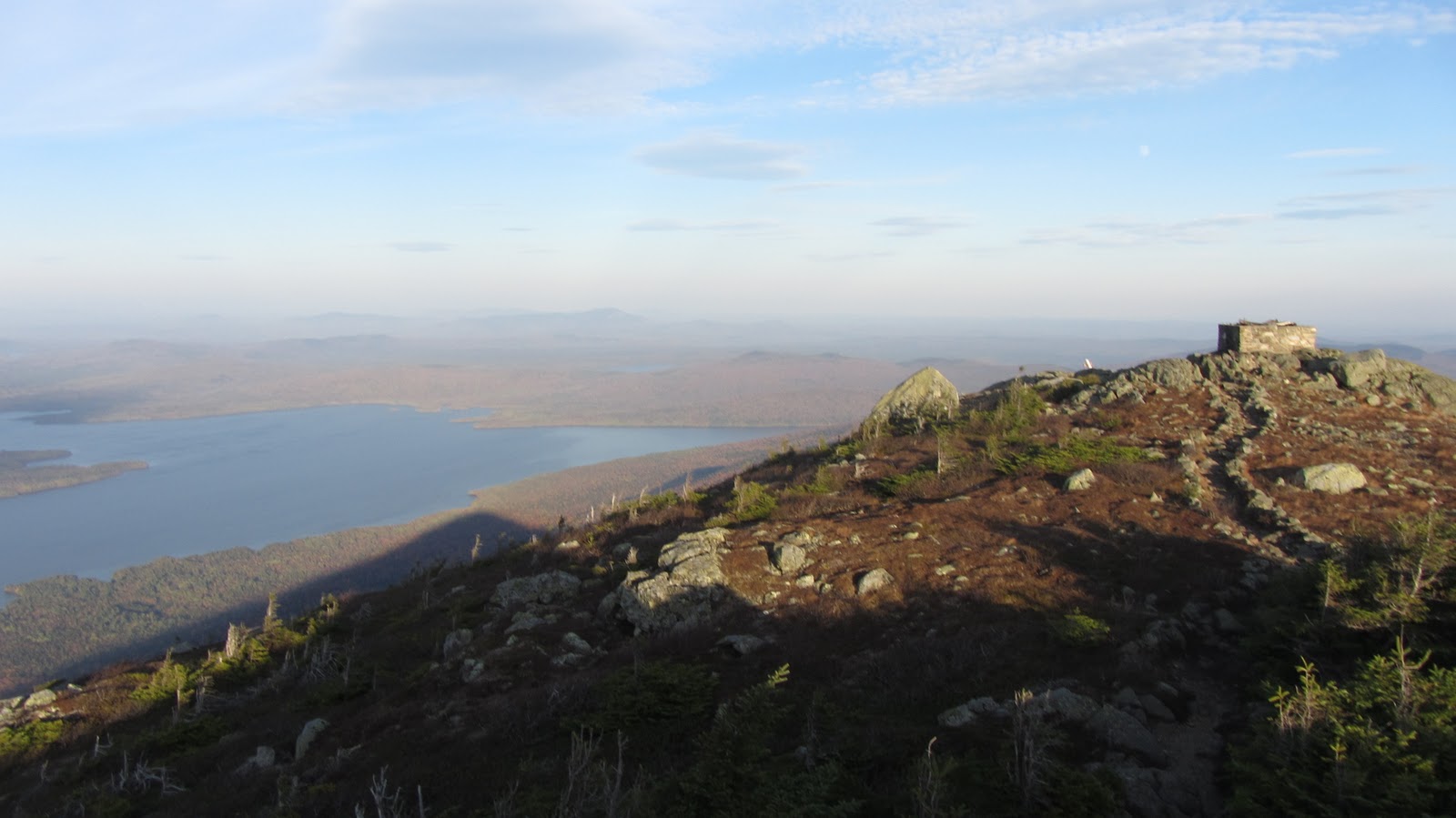
The view immediately after the final summit of the day.  The moon was out and the sun was just about to dip below the mountains behind us.  It would be totally dark in about an hour!
Photo Credit: Ziehl

We reached the final summit about an hour before sunset.  We still had about 3 miles of steep downhill before we were back at Round Barn, and we ended up completing the last hour or so of it by headlamp.  It was nearly a full moon but the foliage prevented much useful light from reaching the forest floor. When we got back to Round Barn, we spent about an hour locating the kayaks in the dark and finding an unoccupied camp site.  We wasted no time in consuming the first PBR (strategically stowed in the Kayaks on Friday night).  With that out of the way, we put up our tents, started a fire and sat around eating for about 2.5 hours before going to bed. Sunday Day two turned out to be another exceptional day.   We pulled our food down, threw together a quick breakfast and started taking down the camp.

Whitecaps on the lake!
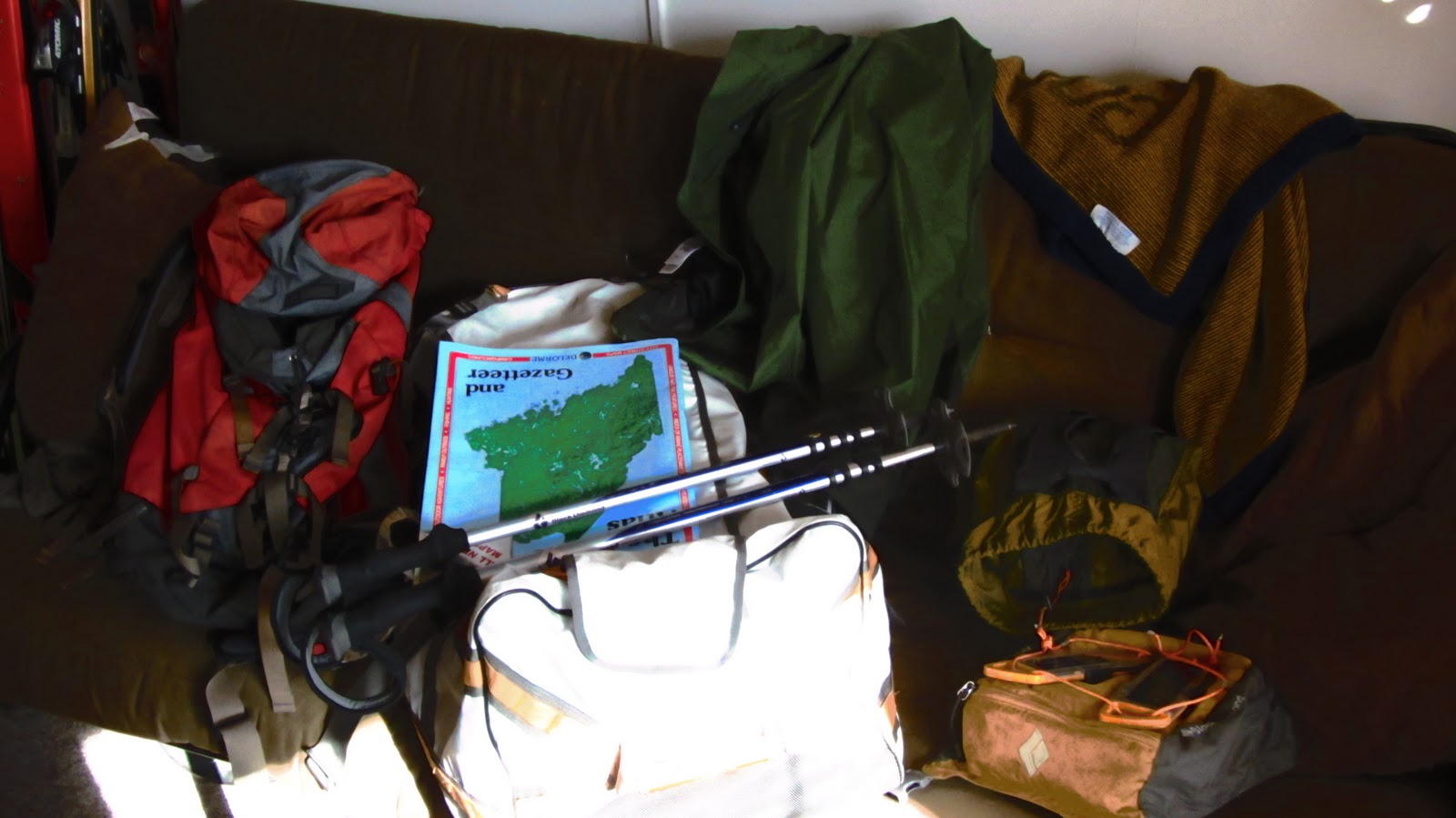
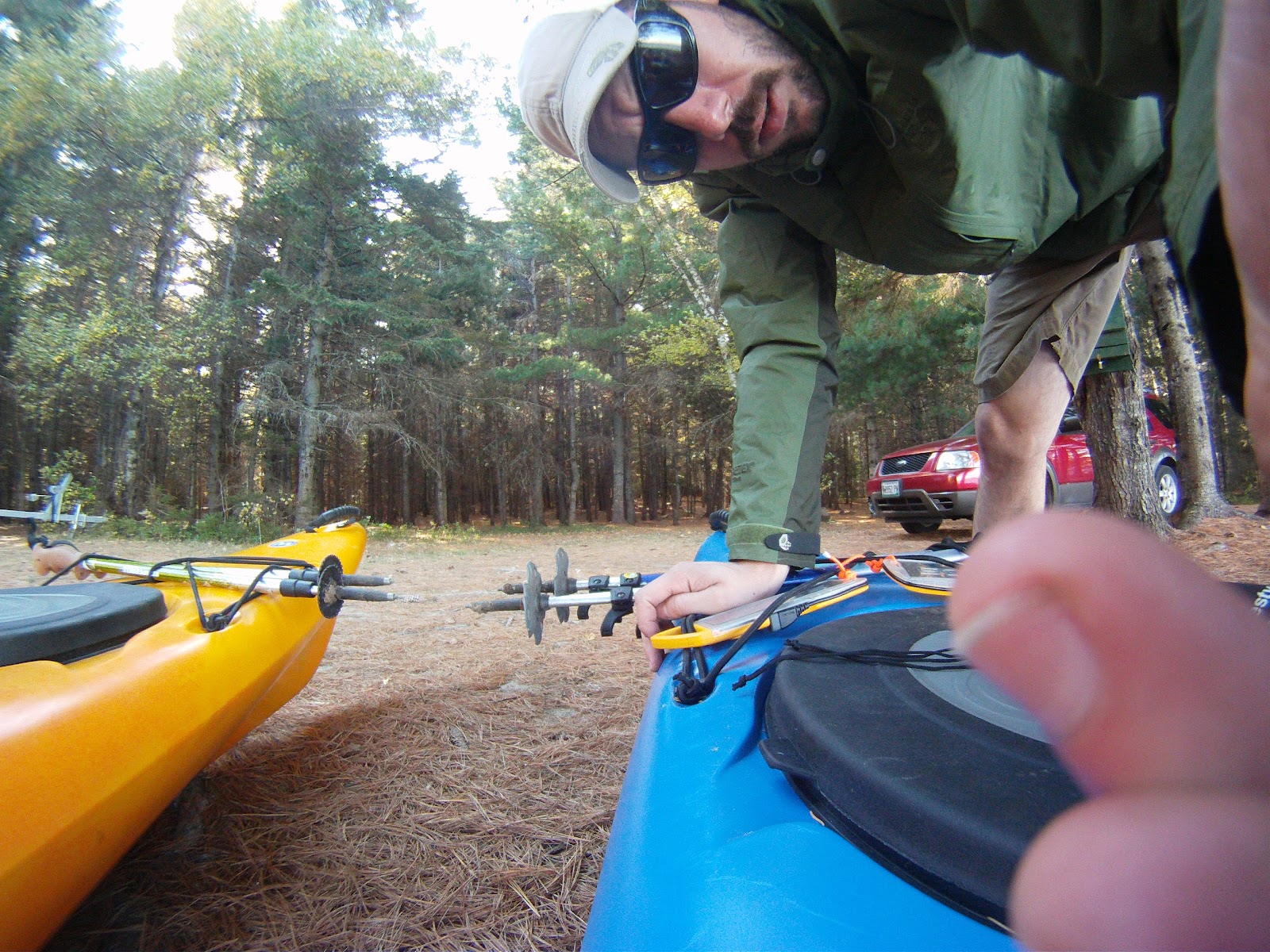
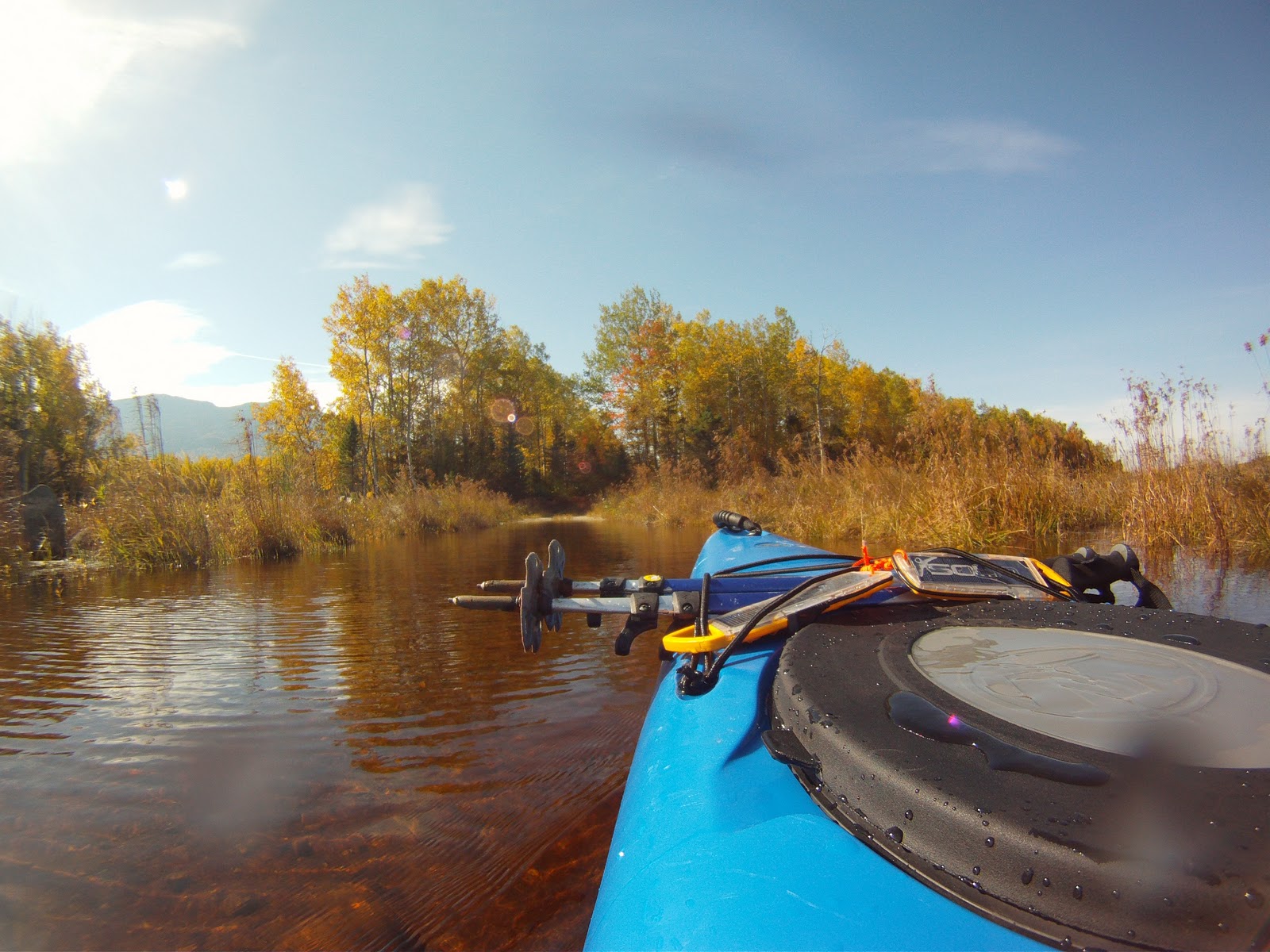
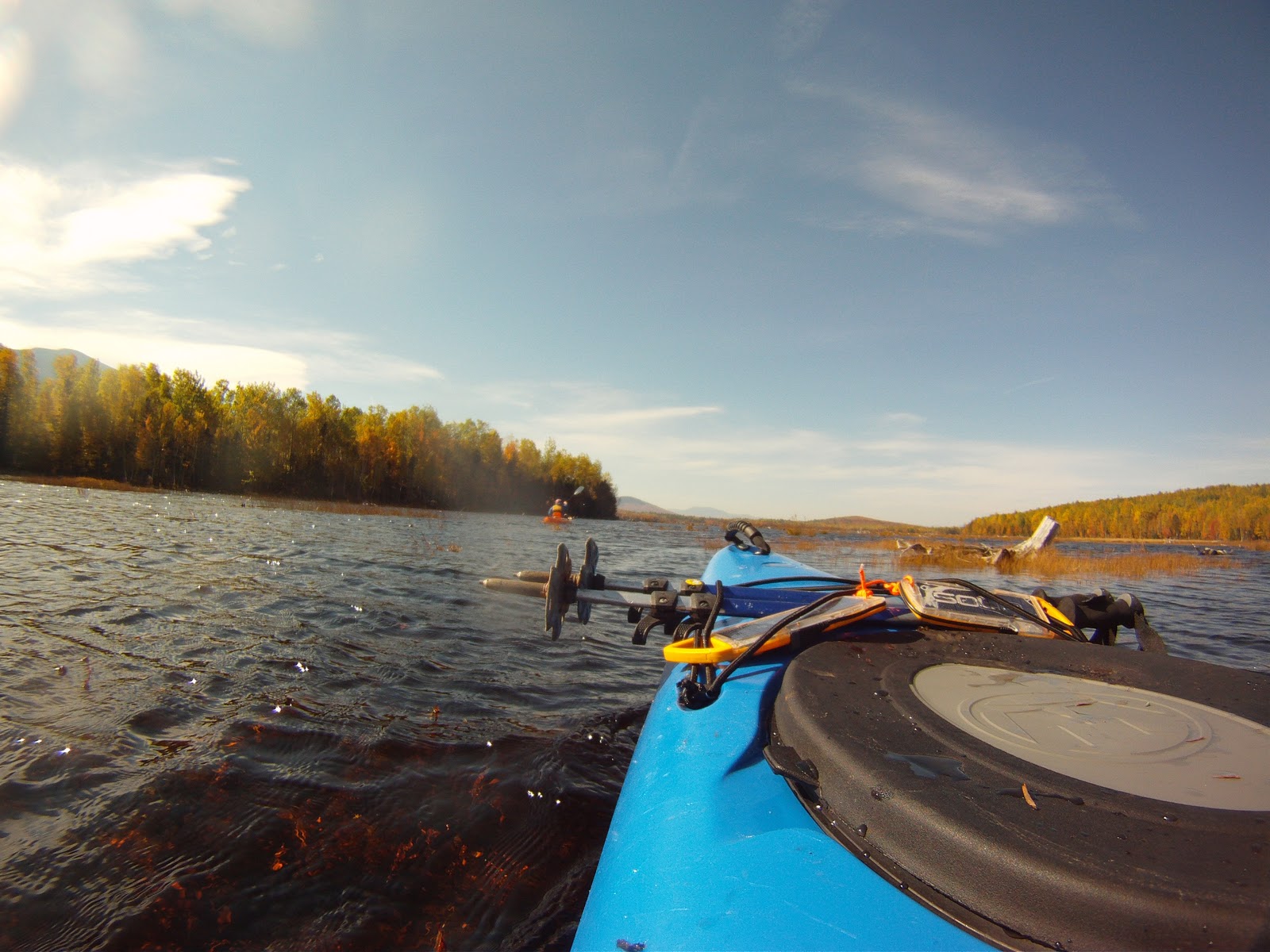
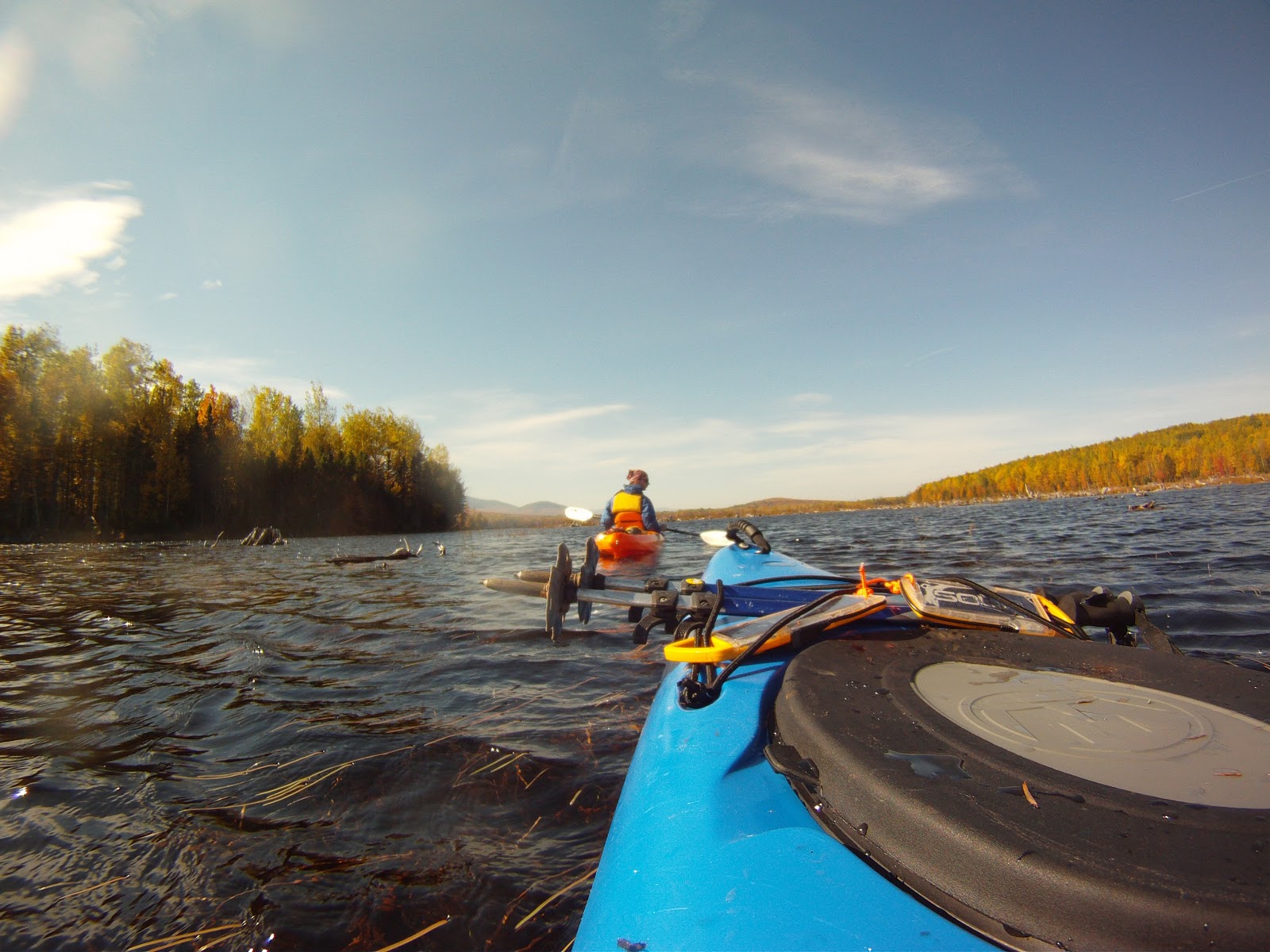
Rigging the kayaks.  The GoPro is right behind my hand.  We stowed the trekking poles with the deck rigging.  Most of the overnight gear was stowed in the main hatch.  We were able to keep extra layers in the rear external stowage using bungee cords.   My two solar chargers are clipped to the bow deck rigging along with the trekking poles.
Under way!
The wind was gusty and the water, choppy at 10 AM, when we departed.

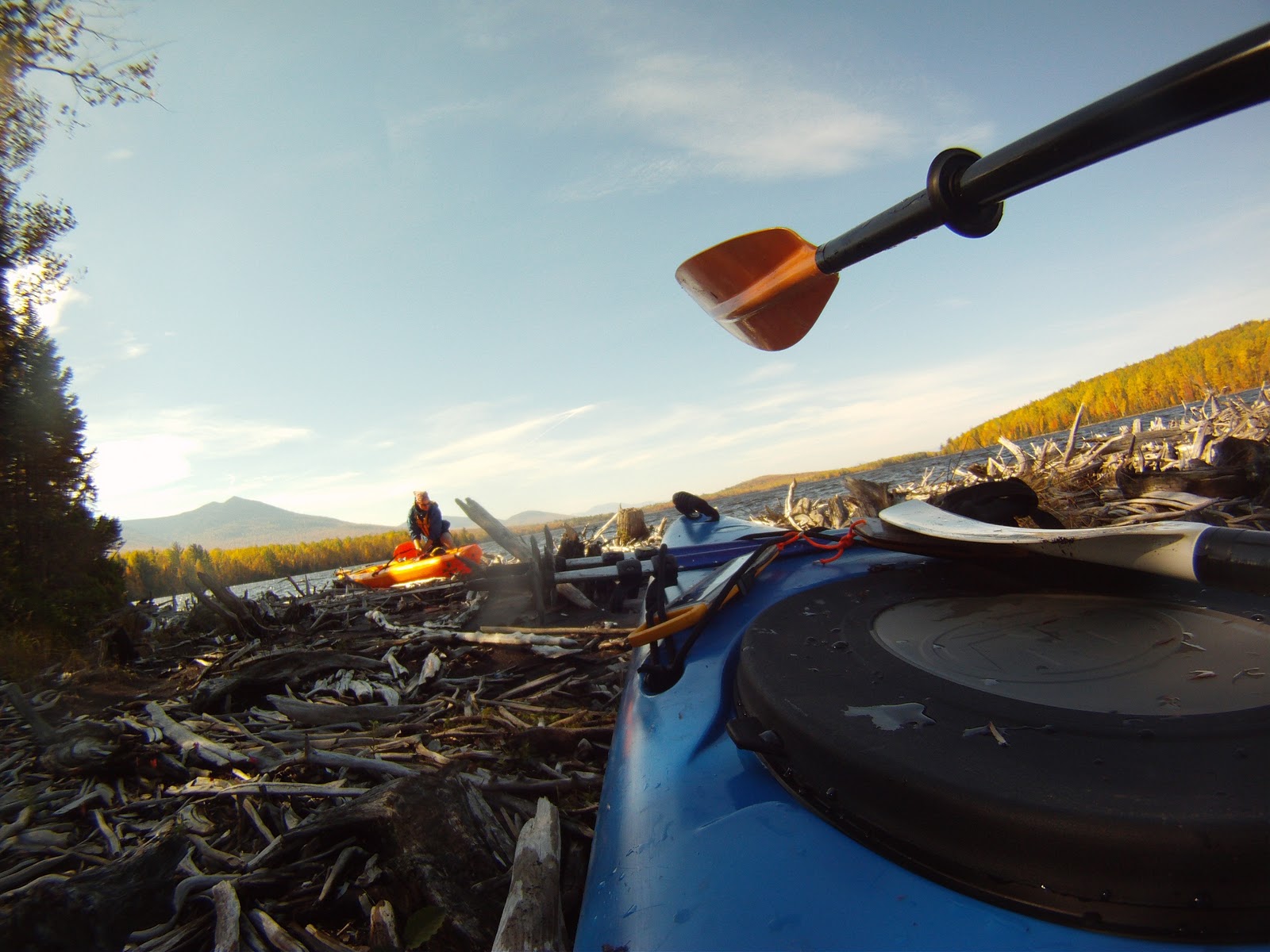
The portage: the road was nearly completely submerged, which worked great for us!  We only had to pull the kayaks out of the water for a few feet.  The western bank of the isthmus was difficult to deal with.  It was mostly flooded and full of weeds and bog-like vegetation which mostly too thick to paddle through and mostly not firm enough to stand on.  The windward bank was a tangled mess of driftwood and dead trees.

View Larger Map

The first portage: a thin isthmus where a road (of red steel gate infamy) crosses the lake.  The road is mostly submerged here.
Reconnoitering…
Finding our way through the second portage.
This may be our best option…
After a lengthy search, we decided to just haul the boats over this mangled pile of driftwood and dead vegetation.
Portage number two.
Hauling the kayaks – they’re way easier to handle when they aren’t full of hiking gear.
Portage two: not so bad after all…
Considering our options…
Checking on the solar panels.
A pit stop…

Now, right around here I must have whacked the shutter button on the GoPro.  So here concludes the GoPro footage.  Fortunately Ziehl, has plenty of still photos from his point and shoot, which I imagine will surface on his page shortly…  Anyhow, be sure to double check that your camera is still recording from time to time! After the portage fiasco was resolved, we encountered pretty smooth sailing for the rest of the day.  We followed the Lake as it wrapped around the Bigelows back toward Stratton.  Eventually we spotted the Boat Ramp across the street from Stratton Elementary School.  We landed the boats and hid them in the bushes while we walked back to the car, about a mile and half away off of Main Street. Reunited with the Pathfinder, we collected the boats, unloaded them, put them back on the roof and went straight for the White Wolf: the only bar in town.  Neither of us had ever been to a bar which was ‘the only bar in town’ and we wanted to see what such a place might be like.  We were pleasantly surprised by the limited yet carefully selected draft list (Long Trail, Carrabassett, Shipyard, Gritty’s) complemented by a none-too-shabby list of bottles.   We had a quick feast, a couple of beers and then set off in search of a camp site for the final night.  We settled on Stratton Brook Pond. Monday We skulked out of our tents, ahead of schedule for the first time of the trip.  After a quick look around, to see what we’d missed in the dark, we tossed our gear in the trunk, rigged the kayaks for the highway and hit the road in search of breakfast.  The Looney Moose in Stratton turned out to be just what the doctor ordered.

Our camp, with the Bigelows in the background.
Sunrise at Stratton Brook Pond.

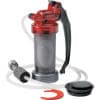
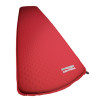
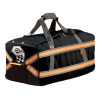
Gear List (click links for more product info): Merrell Chameleon4 Ventilator Gore-Tex Hiking Shoe - Men's Merrell Stone, 10.0Wilderness Systems Tarpon 140 Sit-On-Top Kayak w/ Rudder Mango, One SizeWilderness Systems Tarpon 140 Sit-On-Top Kayak w/ Rudder Blue, One SizeBlack Diamond Contour Elliptic Shock Trekking Pole Ink Blue, StandardMountain Hardwear Sprite 1 Tent 1-Person 3-Season Humboldt, One SizeThule Hull-a-port Kayak CarrierRhino-Rack Single Canoe/Kayak Carrier One Color, Thule/Inno Square/Yakima Round BarsBig Agnes Seedhouse SL2 Tent 2-Person 3-SeasonPetzl Cordex Belay/Rappel Glove Tan, LOakley Bruce Irons Signature Hijinx SunglassesMountain Hardwear Typhoon Jacket - Men's Orb Blue / Blue Chip, XLMountain Hardwear Compressor PL Insulated Hooded Jacket - Men's Sapphire / Blue Chip, SSea To Summit Lightweight Dry Sack Assorted, 20LOutdoor Research Ultralight Dry SackMSR MiniWorks Ex Water Filter One Color, One SizeMSR SweetWater Purifier System One Color, One SizeTherm-a-Rest Prolite Plus Sleeping Pad Pomegranate, STherm-a-Rest Prolite Plus Stuff Sack Pomegranate, SMountain Hardwear Expedition Duffel Bag - 3000 - 8000cu in Black, LGSI Outdoors Pinnacle Dualist Cookset One Color, One SizeMSR SuperFly StovePetzl Tikka XP 2 Headlamp Graphite, One SizeBuy GoPro HERO Camera at GoPro.comFree Shipping on Orders over $50