Rumor has it, that there is some truly great backcountry skiing nestled deep in the
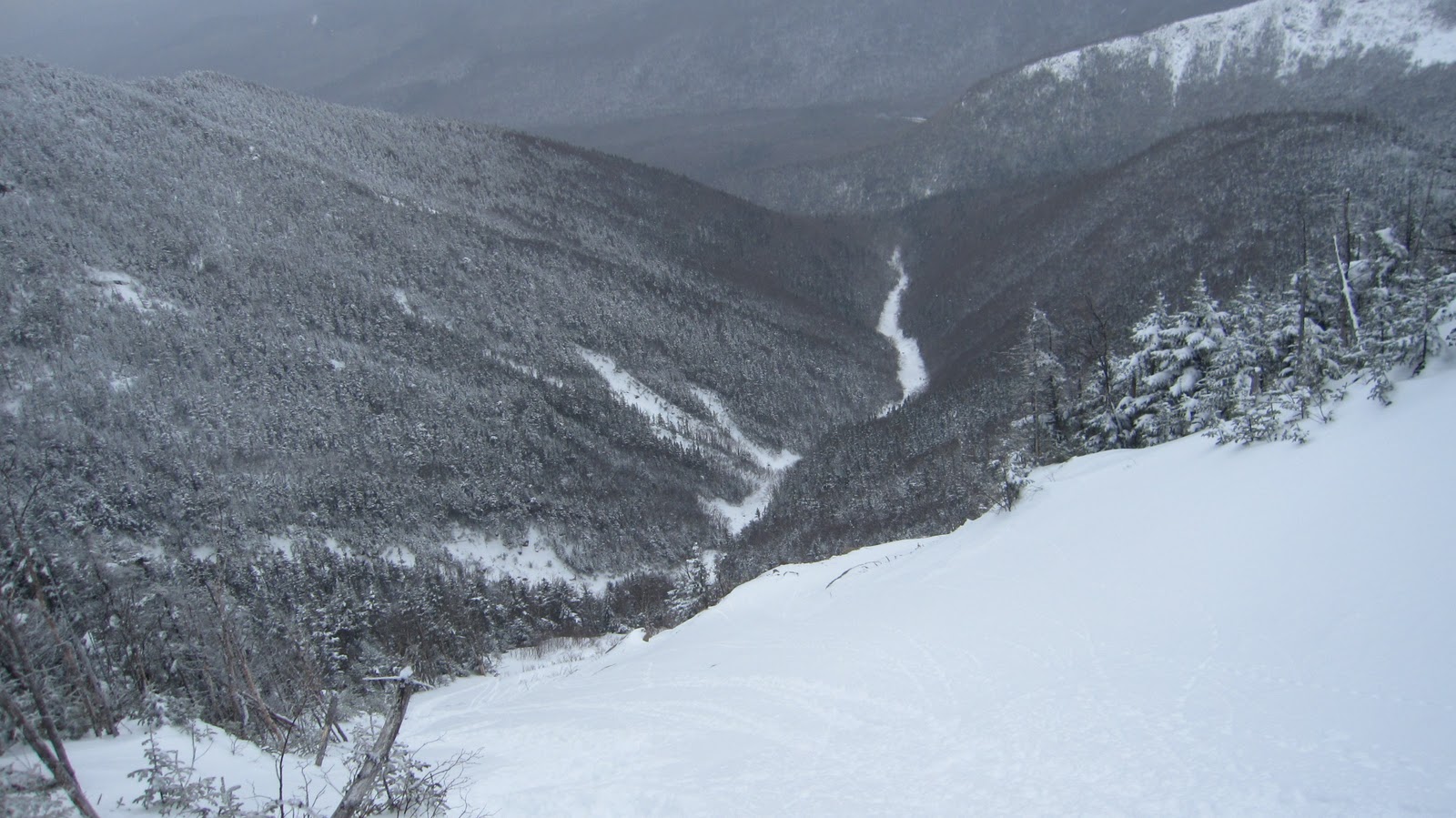
Pemigewasset Wilderness of the White Mountains. My partner in crime Rob, did much of the background research, citing viewsfromthetop and the TGR forums as his main sources. Two sizable and steep bowls punctuate the southwestern flanks of Guyot. Unfortunately the nearest road (in winter at least) is no less than 8 miles away from the either of the bowls. In winter it would likely take the better part of a day to get there, making the minimun reasonable trip length 4 or 5 days: one to get in, one to get out, and 2 or 3 days spent skiing and camping at the base. The goal for the weekend was to ‘swing’ by Guyot, scope out the skiing and assess the whole plan for feasibility unencumbered by winter gear and while conditions are still mild.
View Guyot Recon in a larger map
In order to fit this whole thing into one of the shortening days we’ve been experiencing, we came out of hibernation at the ripe hour of 4:30 on Saturday morning. (Actually the plan was to get up at 4, but my alarm happened to have AM and PM reversed and Rob’s had some similar problem. I just happened to roll over and see that time around 4:20 AM.) We arrived at the trail head around 6 AM and were on the trail shortly thereafter. The sun had just recently crept over the mountaintops.
The first leg of the approach is literally pretty straight forward. You head north along the Lincoln Woods Trail and eventually the Franconia Brook Trail. These trails are formerly a railroad bed used for logging in the late 1800s. The remaining ties and several bridge footings can still be seen for most of the way. As you might expect this part of the hike isn’t that challenging, however it is a pleasant walk alongside all sorts of rivers (notably, the Pemi and Franconia Brook), ponds, and marshes. It’s prime moose country and we even saw some tracks on the trail, highlighted by the light dusting of snow and frost.
View Guyot Recon in a larger map
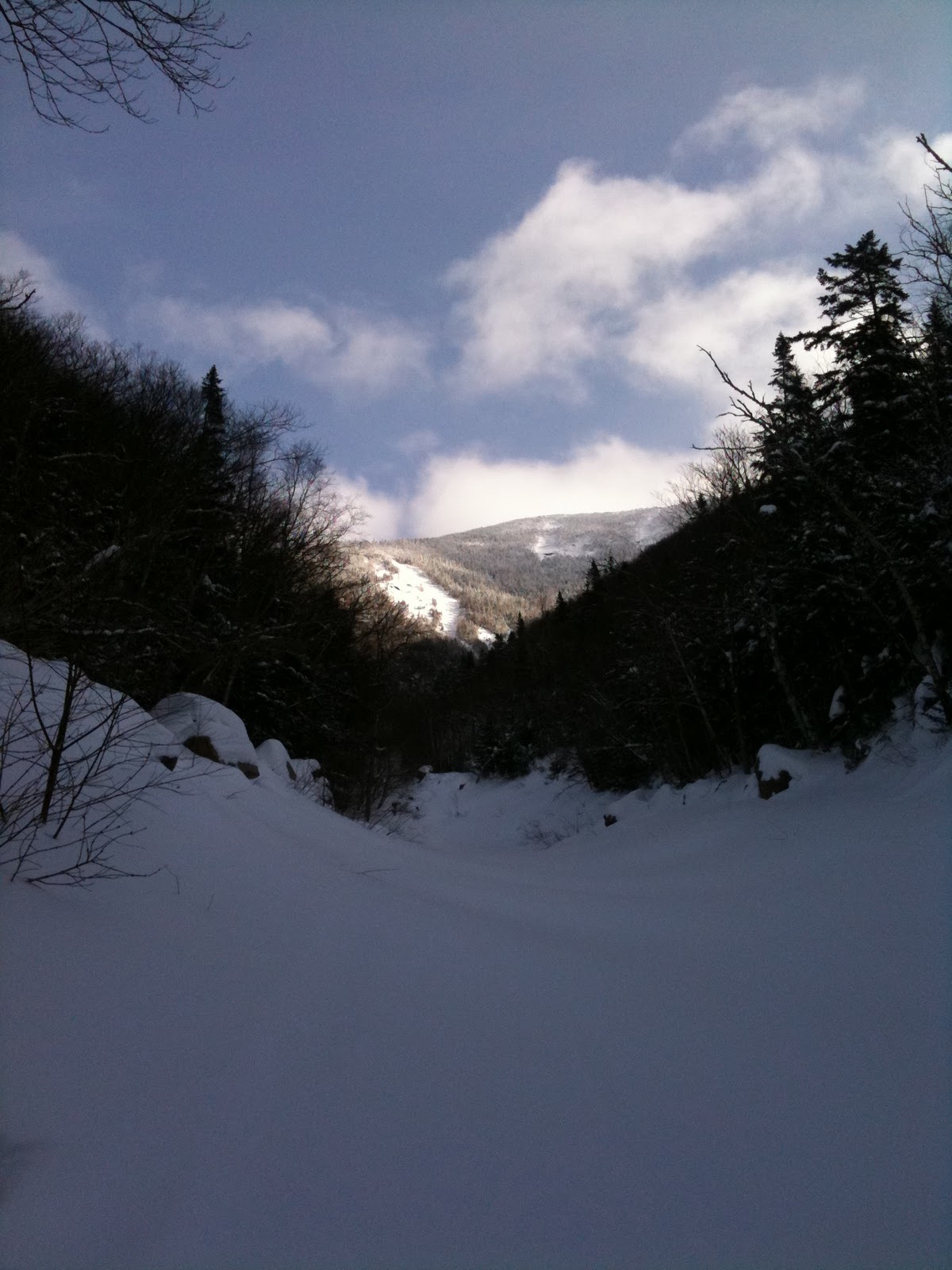
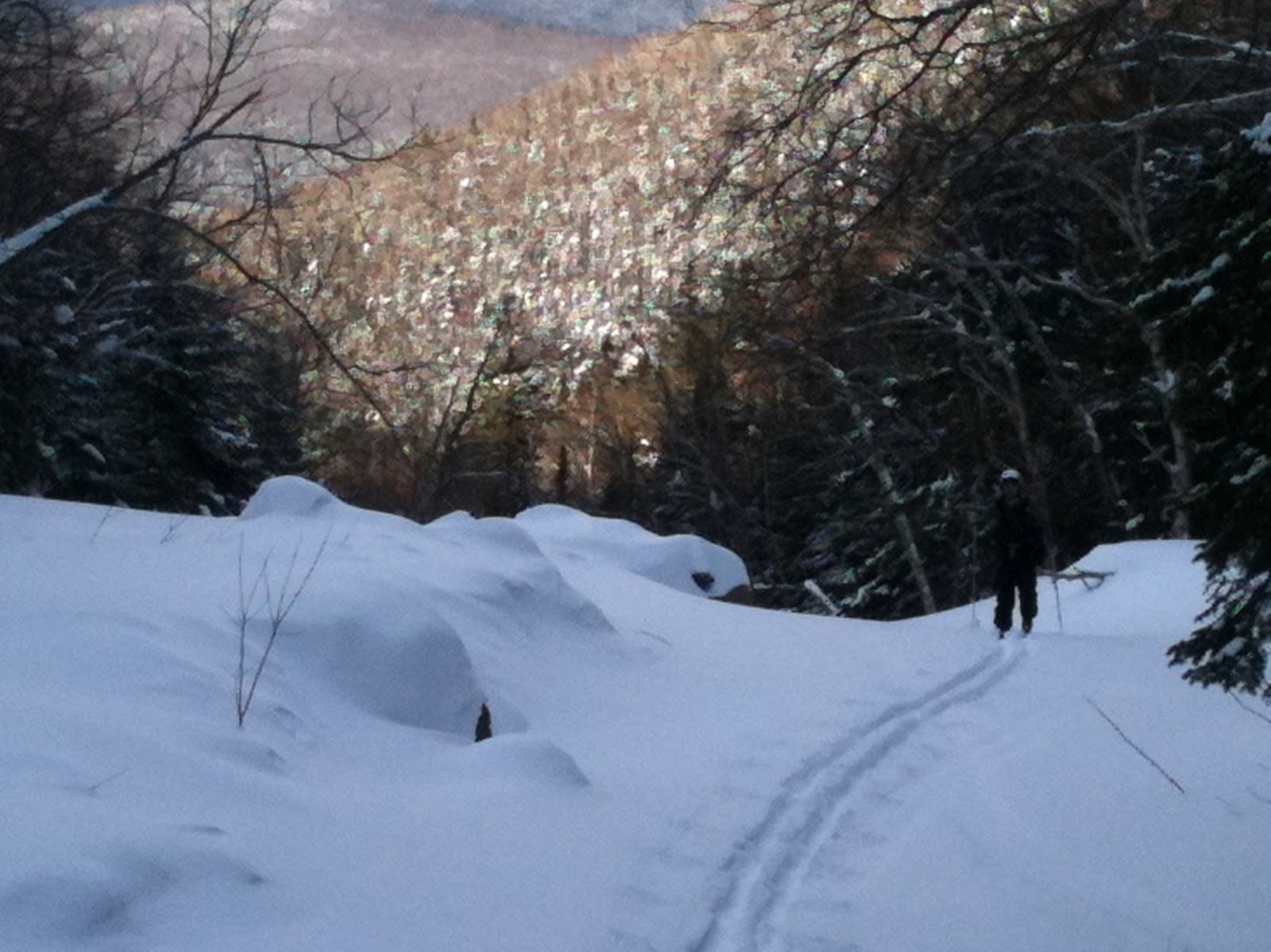
Redrock Brook marks the cutoff point for leaving the trail and heading off toward Guyot, at which point you turn Northeast and follow the brook into the bowls. We made fair time on the 7 mile approach, arriving at the cutoff point in about 3 hours. Having achieved only several hundred feet of elevation, the brunt of the trek was still ahead of us. We had several miles of bushwhacking and about 2000′ of vertical remaining – none of it was on proper trail. There are several abandoned logging roads and rail beds, however all of them are grown in and eroded. In the winter the best route would likely be simply skinning up the brook. We varied our approach, following the stream bed, animal paths, water runoffs and abandoned roads according to whatever seemed easiest. At one point the stream runs almost entirely underground and you can just walk right up the middle of it. However, for the great majority of the slog, you’re plowing through a morass of underbrush. It was a challenge to say the least and our pace slowed considerably.
View Guyot Recon in a larger map
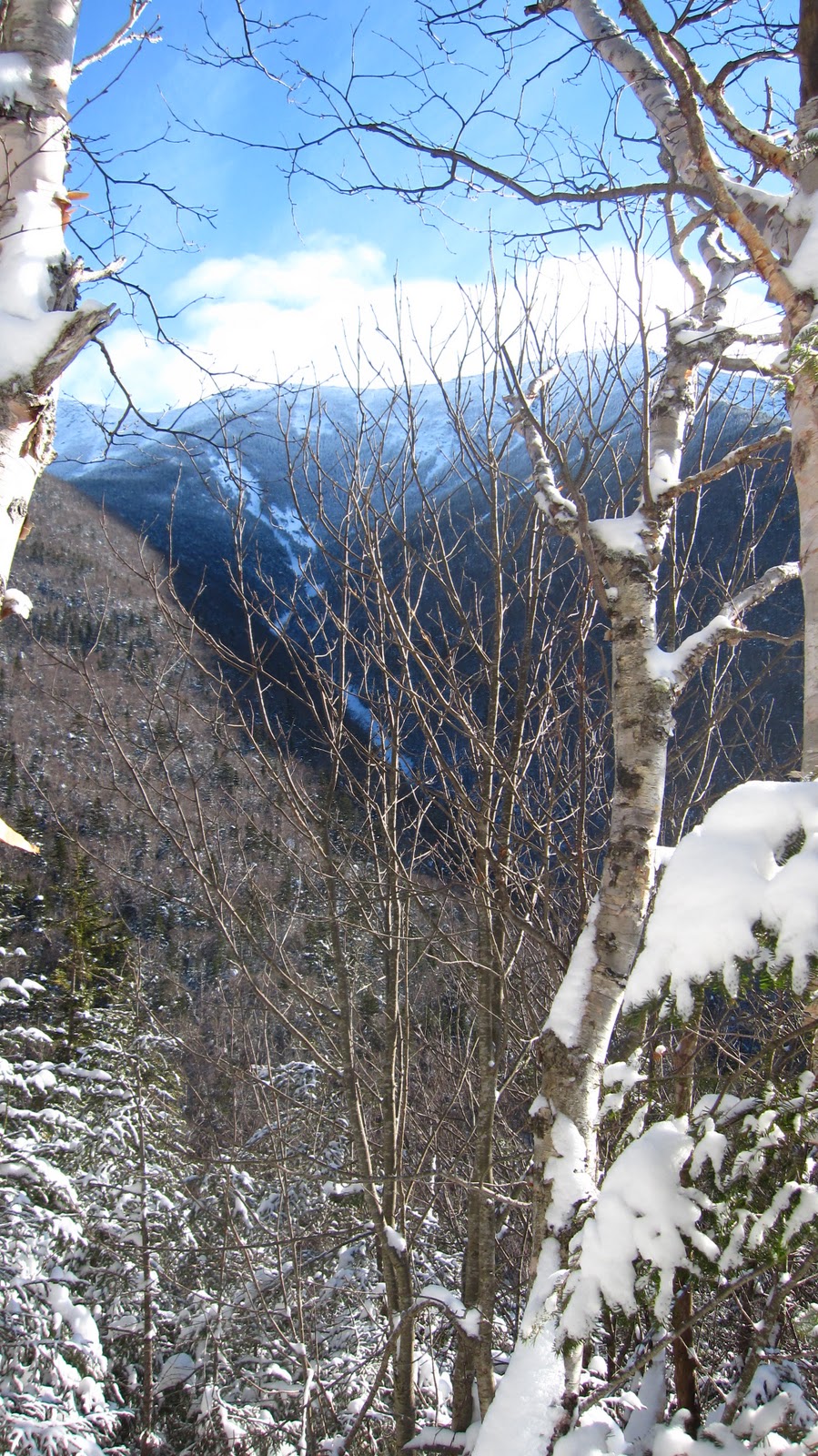
We started the day under cloudy skies, and as the day progressed it became party cloudy with enough sun to warm us whenever we stopped for food and water, however as we gained elevation and got closer to the bowls it was an entirely different story. The wind seemed to funneling up the ravine into the bowls bringing with it plenty of cold and apparently moist air. We made it within 300 vertical feet of souther bowl but by this time virtually all horizontal surfaces were coated in fresh snow. The winds were outright howling and and snow was coming down pretty thick. I was tempted to pull out some of goggles. As we looked up the stream bed we could see that it became increasingly challenging: running water, snow, water ice, boulders, fallen tree…the banks of the stream were dense pine and spruce. It was now past noon and we’d been on the trail for over 5 hours. We had no idea what the weather was outside of the bowls, but it was a full blown blizzard where we were. We decided to call it quits and head back just short of our goal. It would take us another 5 hours at least to ex-filtrate and we would be lucky to be out before sunset.
The slog out was basically the same as the slog in since we mostly just retraced our steps in the snow. We tried to pick up some the abandoned roads which were reputed to be in the area but were not entirely successful in this endeavor. We picked up the actual hiking trail around 3 or 4 and hauled back out to the parking area, just off the Kancamagus. We finished around 4:30 PM after about 17 miles.
While we were unable to get a really good look at the skiing terrain, I have to claim that we accomplished our overall goals. We know the skiing will be great just from looking at topo maps and satellite imagery. The real unknown quantity was the hike into the area, which we now have a very good feel for and have learned many things from. Given the length of time required to get there we can’t really consider going for less than 4 days. Three would work technically, but it seems like a lot of work for only one full day of skiing. Given the duration of our stay in the this exceedingly remote area and the amount of food and other supplies we’d need while there, using sleds or ski-pulks would be mandatory. We’d skin nearly the entire way in. By storing the gear in a duffel lashed to the sled, we would have the ability to carry the entire apparatus short distances for any areas that prove unskinnable, though those would seem to be infrequent given a deep snowpack. An ultralight touring setup would go a long way toward easing our efforts on the way. Something to seriously consider would be purchasing cheap X-country gear and using some kick-wax for the entire approach and hauling the alpine ski gear in the ski-pulks.
Some obvious safety concerns surround the entire trip. It’s considerable remoteness would really force us to be completely self sufficient – if something were to happen we’d be a day away from help in good conditions. Avalanches are a real concern as well, especially with no formal forecasting for that area. We’d have to rely on our own limited forecasting skills and be prepared to make decisions accordingly. We’d also have to be ready to prepare some really weather-proof shelters if the wind and snow are anything like what we witnessed on Saturday. If we were to attempt such a trip, we’d have to wait for an ideal window of weather and avalanche conditions, free up an extended long weekend, prepare the pulks, maybe get X-Country gear, brush up on avy skills, be in seriously good physical condition and finally hope for the best along the way. It would be a pretty serious undertaking but would probably be incredibly fun if well executed.
Gear List (click links for more product info):